Workers servicing industrial machinery face serious risks—unexpected startup, stored energy releases, or uncontrolled movement of parts can lead to amputations, electrocution, or death. A single oversight during maintenance can have irreversible consequences. That’s where a lockout tagout procedure steps in.
A lockout tagout procedure (LOTO) is a safety process used to ensure machines or equipment are safely shut down and cannot be re-energized while undergoing maintenance or servicing. It’s not just a best practice—it’s a legal requirement under OSHA regulations for many industries.
Understanding what a lockout tagout procedure is—and how to implement it correctly—is essential for preventing workplace injuries and maintaining compliance.
The Core Purpose of Lockout Tagout
At its heart, a lockout tagout procedure exists to isolate hazardous energy sources. This includes electrical, mechanical, hydraulic, pneumatic, chemical, thermal, or gravitational energy that could unexpectedly activate equipment.
Without LOTO, a technician working inside a conveyor system could be injured if someone unknowingly restarts the line. Or, a pressurized valve might release scalding steam if residual pressure isn’t properly vented.
LOTO ensures: - Equipment is completely de-energized - Energy sources are physically isolated - Only authorized personnel can restore power - Everyone on-site knows maintenance is underway
It transforms a high-risk situation into a controlled, safe environment.
How a Lockout Tagout Procedure Works: Step by Step
A proper LOTO process follows a strict sequence. Deviating from this sequence—even slightly—can compromise safety. Here’s the OSHA-recommended workflow:
1. Preparation Before shutdown, the authorized employee identifies:
- The type and magnitude of energy involved
- All energy-isolating devices (circuit breakers, valves, disconnects)
- The correct lockout devices needed
Example: A maintenance team preparing to service a hydraulic press must locate the main power disconnect, hydraulic isolation valve, and pressure relief mechanism.
2. Notification All affected employees are informed that maintenance is about to begin. This includes machine operators and nearby staff who may be impacted.
3. Equipment Shutdown
Using normal stopping procedures (e.g., pressing emergency stop, closing valves), the machine is shut down. This is not the same as unplugging a tool—it’s a controlled operational halt.
4. Isolation of Energy Sources All energy-isolating devices are physically turned off or closed. Examples: - Circuit breakers switched to “off” - Valves closed and bled - Blocks placed under elevated parts to prevent dropping
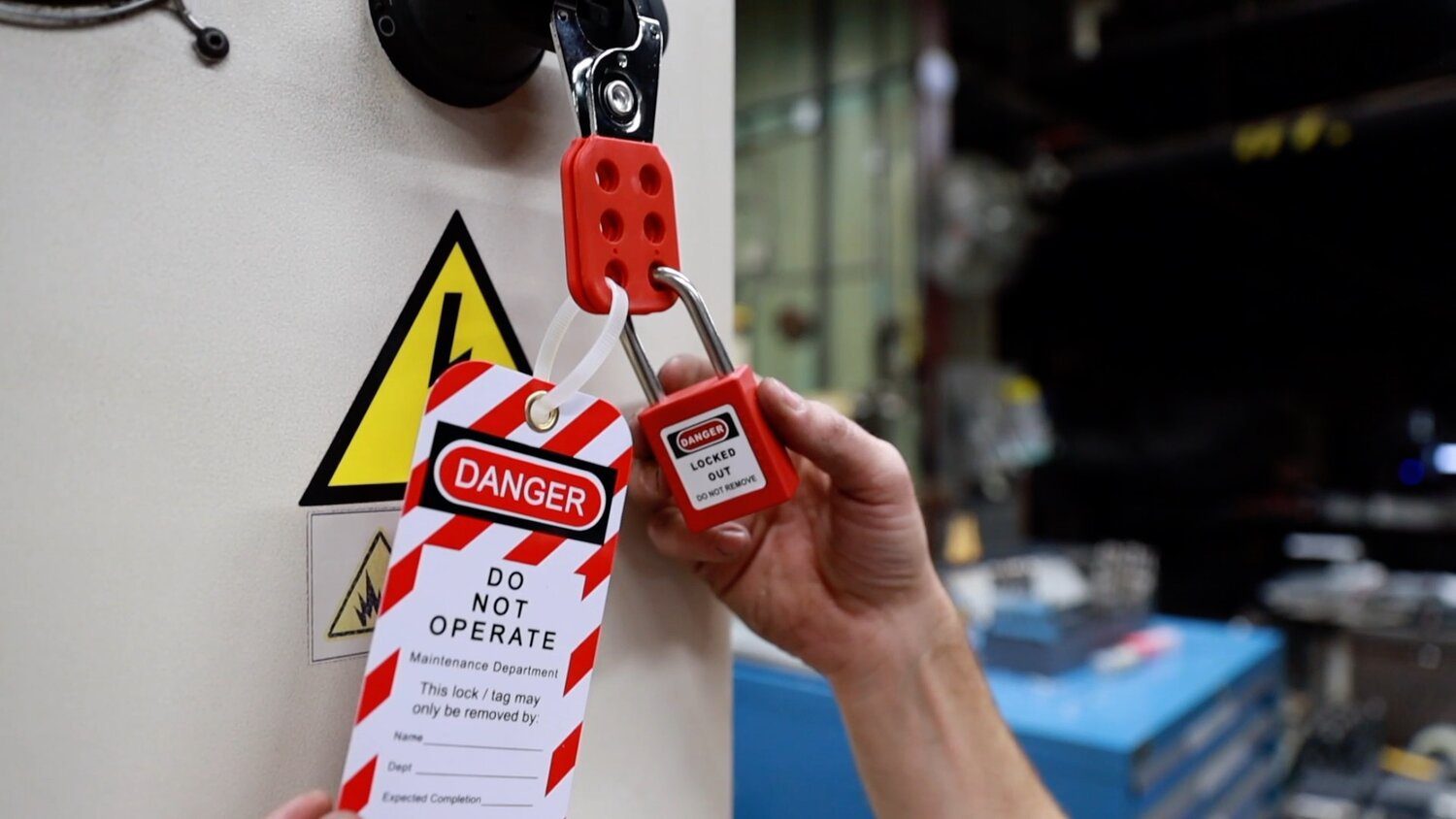
5. Application of Lockout/Tagout Devices Each isolating device is secured with a lock and tagged with a warning label. The lock prevents re-energization; the tag explains why and who applied it.
Crucially, each lock is personal—assigned to one employee. This means one person, one lock, one key.
6. Release of Stored Energy Even after isolation, energy may remain. Springs under tension, capacitors, elevated loads, or pressurized lines must be safely discharged.

Example: A technician might manually release compressed air from a pneumatic line or lower a suspended component using a hoist.
7. Verification of Isolation The final and most critical step: trying to restart the equipment.
After ensuring no one is near the machine, the authorized employee attempts to turn it on using the normal start controls. If it doesn’t start, isolation is confirmed. If it does, the process failed—go back and recheck.
Only after successful verification is the equipment safe to service.
Lockout vs. Tagout: What’s the Difference?
Though often used together, lockout and tagout are distinct components:
| Feature | Lockout | Tagout |
|---|---|---|
| Physical Device | Yes (lock, hasp, chain) | No |
| Prevents Operation | Mechanically blocks access | Relies on warning |
| Required for Full Compliance | Yes, where possible | Only when lockout isn’t feasible |
| Durability | Metal or durable plastic | Paper or laminated tag |
OSHA allows tagout-only procedures only if: - The tag provides a level of protection equivalent to lockout - Additional safety measures (e.g., removing isolation rods, using spare keys) are implemented - Employees are trained on the limitations
Bottom line: Lockout is always preferred. Tagout is a secondary measure when physical locking isn’t possible.
Common Mistakes That Undermine LOTO Effectiveness
Even facilities with LOTO programs in place often make critical errors. These reduce protection and increase liability:
❌ Using Group Locks Without Individual Accountability Some teams use one lock for multiple workers. This violates OSHA standards. Each worker must apply their own lock. If five people are working, five locks are required.
❌ Skipping Stored Energy Release A technician shuts off power but doesn’t bleed hydraulic lines. When they open a valve, high-pressure fluid sprays out—causing injury.
❌ Incomplete Energy Source Identification Failing to recognize all energy inputs (e.g., ignoring pneumatic lines) leaves dangerous pathways active.
❌ Poor Tag Information Tags that say “Do Not Operate” without a name, date, or reason offer little value. Tags must clearly indicate who locked it and why.
❌ Untrained Employees Performing LOTO Only authorized employees should perform LOTO. Affected employees (machine operators) need awareness training, but not full procedure authority.
Fix these gaps with regular audits, refresher training, and visual checklists at equipment points.
Real-World Applications of Lockout Tagout
LOTO isn’t abstract—it’s applied daily in high-risk environments. Consider these examples:
Manufacturing Line Maintenance A robotic arm on an assembly line requires welding repairs. The technician: - Notifies supervisors and operators - Powers down the robot’s control panel - Locks the main circuit breaker and hydraulic valve - Releases residual pressure - Verifies isolation by attempting startup
No one can restart the arm until all locks are removed.
HVAC System Repair A boiler needs internal inspection. The maintenance team:
- Closes fuel supply valves and locks them
- Tags disconnect switches
- Depressurizes steam lines
- Confirms temperature has dropped to safe levels
Only then do they open the access panel.
Electrical Panel Upgrades An electrician upgrades a breaker panel. They:
- Shut off main power
- Lock the disconnect with a personal lock
- Test for zero energy with a voltage meter
- Apply a tag with their name and purpose
Even in low-voltage settings, LOTO prevents accidental contact and arc flashes.
LOTO Devices: Tools That Make the Process Work
Effective LOTO relies on physical devices designed for safety and durability. Standard equipment includes:
- Padlocks – Personal, keyed or combination locks used by each authorized employee
- Lockout Hasps – Allow multiple locks to be applied to a single isolation point
- Valve Lockouts – Clamp onto valve handles to prevent turning
- Circuit Breaker Lockouts – Secure breakers in the “off” position
- Plug Lockouts – Prevent reinsertion of electrical cords
- Tagout Tags – Durable, tamper-resistant labels with space for name, date, reason
Using standardized, high-quality devices ensures reliability. Cheap plastic locks or flimsy tags degrade over time and fail when needed most.
Why Compliance Is Non-Negotiable
OSHA standard 29 CFR 1910.147 outlines strict requirements for control of hazardous energy. Non-compliance isn’t just risky—it’s expensive.
- Average OSHA LOTO violation fine: $14,502 per instance
- Willful or repeated violations: Can exceed $145,000
- Criminal penalties: Possible if willful neglect leads to death
Beyond fines, companies face: - Increased workers’ compensation claims - Downtime from incidents - Reputational damage - Loss of employee trust
A robust LOTO program isn’t a cost—it’s risk mitigation.
Building a Reliable LOTO Program
Creating a functional LOTO system requires more than posting a sign. Follow these steps:
1. Conduct an Energy Control Survey Walk every facility area. Identify all machines with hazardous energy. Document energy types and isolation methods.
2. Develop Machine-Specific Procedures One-size-fits-all doesn’t work. Each machine needs a written LOTO procedure including: - Step-by-step shutdown and isolation instructions - Location of energy controls - List of required lockout devices - Verification method
3. Train Employees
- Authorized employees: Full training on implementing LOTO
- Affected employees: Understand the purpose and never tamper with locks/tags
Training must be re-evaluated annually or when processes change.
4. Perform Periodic Inspections At least once per year, a supervisor must audit LOTO procedures in practice. Observe actual lockout events, review documentation, and correct deviations.
5. Document Everything Keep records of training, procedures, inspections, and incidents. Documentation proves due diligence in case of an audit or injury.
Conclusion: LOTO Is Safety, Not Bureaucracy
A lockout tagout procedure isn’t paperwork for compliance’s sake. It’s a life-saving protocol that protects workers from preventable harm. When done right, it creates a culture where safety is visible, consistent, and non-negotiable.
Implementing LOTO isn’t complicated—but it must be thorough. Identify energy sources, train your people, use proper devices, and verify every time.
No machine is worth a life. Lock it out. Tag it out. Stay safe.
Frequently Asked Questions
What is the main goal of a lockout tagout procedure? To ensure machines are completely de-energized and cannot be restarted during maintenance, protecting workers from hazardous energy.
Who is responsible for applying lockout tagout devices? Only authorized employees—those trained and responsible for implementing the energy control program.
Can you use only tags without locks? Only if locks aren’t feasible and additional protective measures are in place. Lockout is always the preferred method.
How often should LOTO procedures be reviewed? At least annually, and whenever equipment or processes change.
What happens if someone removes a lockout device early? It’s a serious violation. Only the person who applied the lock should remove it, unless a formal removal procedure is followed.
Do small tools require LOTO? Yes, if they store energy or pose a hazard during servicing—even handheld tools with springs or capacitors.
Is LOTO required for routine production tasks? No—for minor, repetitive tasks like jam clearing, alternative methods like machine guarding may suffice under OSHA’s minor servicing exception.
FAQ
What should you look for in What Is a Lockout Tagout Procedure: A Complete Guide? Focus on relevance, practical value, and how well the solution matches real user intent.
Is What Is a Lockout Tagout Procedure: A Complete Guide suitable for beginners? That depends on the workflow, but a clear step-by-step approach usually makes it easier to start.
How do you compare options around What Is a Lockout Tagout Procedure: A Complete Guide? Compare features, trust signals, limitations, pricing, and ease of implementation.
What mistakes should you avoid? Avoid generic choices, weak validation, and decisions based only on marketing claims.
What is the next best step? Shortlist the most relevant options, validate them quickly, and refine from real-world results.